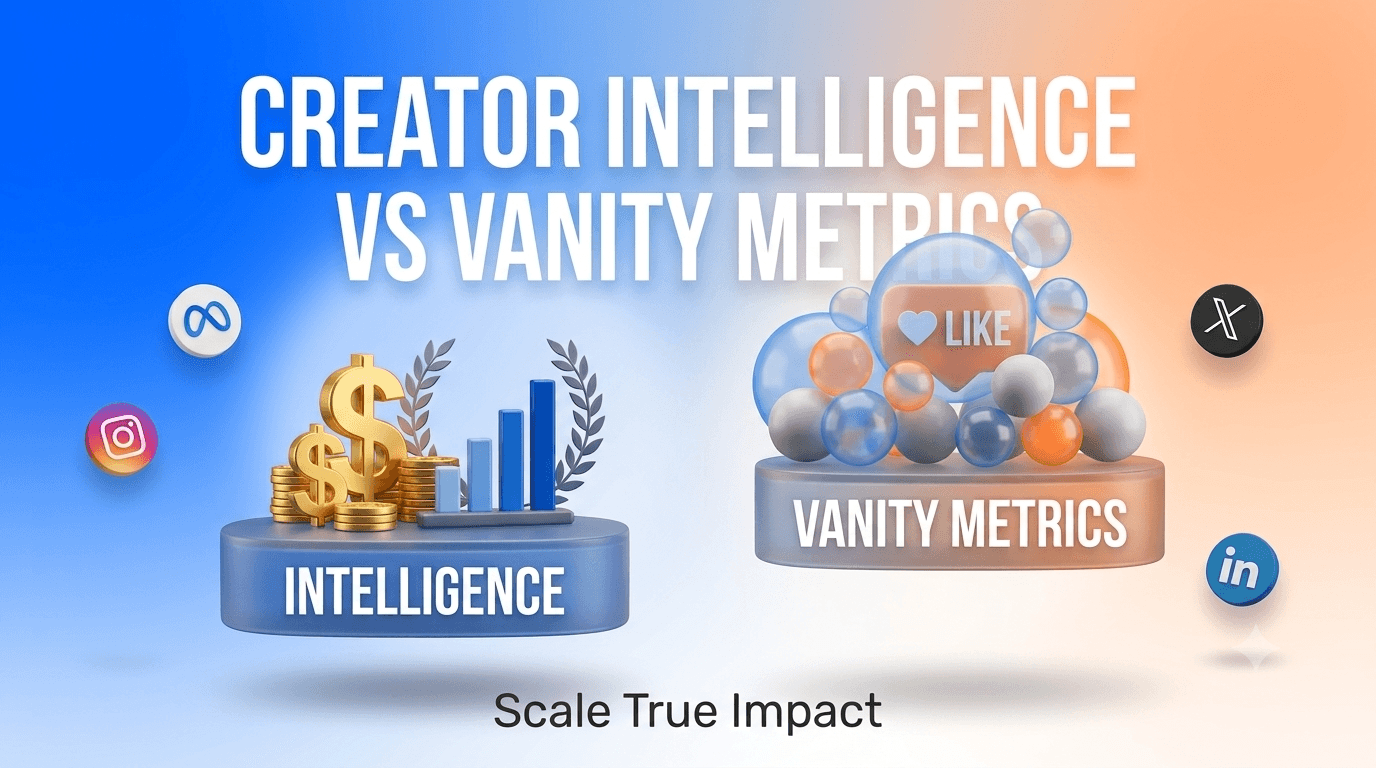
Creator Intelligence vs Vanity Metrics | Adminting

Chukwunyere Ebube
August 4, 2026
How Creator Intelligence Beats Vanity Metrics in Influencer Marketing
In 2026, the global influencer economy is projected to surpass $30 billion, with emerging markets across Africa, particularly Nigeria, Kenya, and South Africa, experiencing an unprecedented surge in digital content consumption. However, despite millions of Naira and Dollars poured into sponsored posts daily, over 60% of brand managers still struggle to calculate clear campaign ROI.
Why does this disconnect exist? The fundamental problem lies in our reliance on outdated reporting tools; for instance, over a decade, marketing teams have evaluated creators using vanity metrics like follower counts, surface-level likes, and inflated impression numbers. Unfortunately, these superficial figures fail to indicate whether an audience possesses genuine purchasing power or buying intent.
Therefore, to thrive in today's performance-driven ecosystem, forward-thinking organizations must transition toward creator intelligence. In this comprehensive guide, we will explore why vanity metrics deceive brands, break down the core pillars of audience data science, and demonstrate how Adminting's proprietary framework turns influencer campaigns into reliable revenue engines.
Let us look at a real-world scenario from the vibrant commercial hub of Lagos, Nigeria. In early 2025, a rapidly growing fintech brand, we will call them Brand X, launched a major campaign to promote their new multi-currency digital wallet. Seeking rapid market penetration, they hired five top-tier lifestyle influencers, each boasting over 800,000 followers on Instagram and TikTok.
The campaign launch appeared to be an immediate success on the surface:
- Total Reach: 4.2 Million Impressions
- Likes Generated: 180,000+
- Comments Received: 12,000+
- Total Spent: ₦15,000,000 ($10,000 USD)
The brand's internal Slack channels exploded with celebration. Consequently, the executive leadership team eagerly checked their backend dashboard to monitor app downloads and account activations.
The result? Fewer than 140 new account registrations were completed, yielding a disastrous Customer Acquisition Cost (CAC) exceeding ₦107,000 per user.
| Total Ad Spend | ₦15,000,000 (~$10,000 USD) |
| Surface Engagement | 192,000 Total Engagements |
| Actual Account Sign-Ups | 140 Users |
| Real Acquisition Cost | ₦107,142 per active user |
When Adminting performed a forensic post-campaign audit, the underlying issues became immediately clear. Over 45% of the engagement had been driven by automated comment pods ("Fire emoji" comments). Furthermore, 35% of the impressions originated from audiences outside the fintech app's operational jurisdiction, and the remaining audience viewed the content purely as passive entertainment without any buying intent.
Brand X paid premium rates for reach, but they received zero market penetration. This expensive mistake illustrates why relying on superficial metrics fails in modern digital marketing.
By reading this ultimate guide, you will learn how to systematically audit your creator portfolio, eliminate wasted ad spend, deploy data-driven audience sentiment frameworks, and execute influencer campaigns that yield measurable, bottom-line revenue for your brand.
How do brands transition from speculative influencer spend to data-validated revenue generation?
Brands make this critical transition by moving away from manual, follower-first talent discovery and adopting automated creator intelligence architectures. Instead of asking "How many followers does this creator have?", sophisticated marketing teams ask "What percentage of this creator's active audience matches our target customer profile, and what is their historical conversion rate?"
By implementing multi-touch attribution modeling, analyzing comment sentiment, and verifying audience demographic locations prior to signing contracts, brands build predictable, scalable influencer pipelines.
The Fallacy of Vanity Metrics in Modern Marketing
To understand why creator intelligence is necessary, we must first analyze why vanity metrics fail to deliver business value.
| SURFACE METRICS | BUSINESS REALITY | |
|---|---|---|
| Follower Count | → | Bots & Inactive |
| Surface Likes | → | Passive Scrolling |
| Raw Impressions | → | Off-Target Traffic |
1. Follower Count vs. Active Audience Reach
Follower count represents the aggregate number of user accounts registered as subscribers to a specific social profile. Brands historically used follower counts as a proxy for broadcast reach. However, platform algorithms (such as Instagram's AI ranking and TikTok's For You Page architecture) limit organic distribution to roughly 2%–8% of a creator's total follower base.
Brands must stop relying on total follower counts. Instead, request verified platform analytics showing 30-day active reach, median view rates on video content, and audience geographical distribution.
2. Surface Likes vs. Authentic Engagement
Surface likes represent a single tap on a screen, a low-friction interaction that requires minimal thought or attention from the user. A double-tap does not signify purchase intent, brand recall, or emotional connection.
Meanwhile, comment pods, automated scripts, and click farms artificially inflate like counts for pennies per thousand interactions. Evaluate engagement depth by measuring high-intent actions: long-form comments, direct shares, link clicks, bookmarks, and direct message (DM) inquiries regarding product availability.
3. Raw Impressions vs. Target Market Attention
Impressions measure the total number of times a piece of media was rendered on a user's screen, regardless of whether the user paid attention to it or scrolled past in milliseconds. An impression counted on a user scrolling rapidly through a feed provides zero cognitive retention.
Furthermore, if those impressions land on users in regions where your product cannot ship, that ad spend is completely wasted. Focus on qualified impressions, views that last longer than 3 seconds on video formats, combined with precise location tracking to ensure your budget targets actionable prospects.
Metric Comparison Matrix
| Metric Category | Primary Metrics Tracked | Why It Fails Modern Marketers | Modern Creator Intelligence Alternative | Direct Business Impact |
|---|---|---|---|---|
| Vanity Metrics | Total Followers, Page Likes, Raw Impressions | Easily inflated via bots; zero correlation with buyer intent or location validity. | Audience Authenticity Score & Active Monthly Reach | Prevents budget waste on fake or off-target accounts. |
| Surface Engagement | Like Count, Generic Comments (Emoji pods) | Measures passive scrolling rather than active interest or purchasing consideration. | Deep Interaction Ratio (Saves, Shares, High-Intent Comments) | Higher brand recall and improved mid-funnel consideration. |
| Creator Intelligence | Audience Affinity, Conversion Attribution, Sentiment Index | Requires advanced tooling, but directly maps creator alignment to actual sales revenue. | Multi-Touch First-Party Tracking (Custom UTMs, Pixel Data) | Predictable ROAS, lower CAC, and scalable campaign performance. |
Defining Creator Intelligence: The New Standard
Creator intelligence represents the evolution of influencer marketing from speculative talent acquisition into a precise, data-driven science. It combines big data analytics, natural language processing (NLP), machine learning, and consumer psychology to deliver a complete picture of a creator's value.
| CREATOR INTELLIGENCE ENGINE | |||
|---|---|---|---|
| Audience Audit | Behavioral Affinity | Conversion Attribution | Sentiment Analysis |
Pillar 1: Audience Authenticity & Bot Detection
Audience authenticity auditing uses probabilistic algorithms to identify non-human accounts, engagement pods, and inactive profiles within a creator's follower ecosystem. Paying for broadcast access to bot accounts severely reduces campaign return on investment.
Use platform tools to analyze follower growth curves. Natural growth exhibits steady upward movement with periodic spikes corresponding to viral content. Conversely, sudden vertical jumps followed by sharp drops indicate purchased follower packages.
Pillar 2: Behavioral Affinity & Niche Relevance
Behavioral affinity measures how closely a creator's audience aligns with your brand's ideal customer profile (ICP) based on shared interests, media consumption habits, and purchasing behaviors.
A creator may talk about tech, but if their audience primarily follows them for comedic skits, technology endorsements will underperform.
Analyze the overlapping interests of the audience. Use natural language processing to extract recurring keywords, hashtags, and brands mentioned within the creator's comment section.
Pillar 3: Historical Performance & Conversion Attribution
Historical conversion analysis reviews a creator's track record of driving specific consumer actions, such as clicks, app downloads, lead form fills, and checkout completions. Some creators excel at top-of-funnel brand awareness, whereas others excel at driving direct conversions. Matching campaign objectives with creator strengths is vital for success.
Request historical campaign case studies from potential creator partners. Review past click-through rates (CTR) and conversion rates (CVR) across previous sponsored collaborations in your industry.
Pillar 4: Community Sentiment & Brand Safety
Community sentiment analysis evaluates the emotional tone of audience interactions, measuring whether comments express positive, neutral, or negative feelings toward the creator and their sponsors.
High engagement numbers can mask hostile audience sentiment. Partnering with controversial figures without analyzing sentiment can damage your brand's reputation.
Run automated sentiment analysis across the creator's last 50 posts. Classify comment tones into distinct buckets (e.g., Enthusiastic, Inquiring, Indifferent, Critical) to confirm positive brand perception.
How Adminting Pioneers Creator Intelligence Strategy
At Adminting (adminting.com), we have developed a data-first framework that eliminates guesswork from influencer marketing across Nigeria, the broader African continent, and international markets.
| Stage | Description |
|---|---|
| 1. DISCOVERY | Deep algorithmic search & demographic filtering |
| 2. AUDIT | Fraud detection, audience validity & sentiment scoring |
| 3. STRATEGY | Briefing, messaging alignment & native content design |
| 4. EXECUTION | Dynamic links, attribution pixels & live optimization |
| 5. REPORTING | Real-time ROAS, CAC analysis & full ROI breakdown |
The Adminting Creator Execution Methodology
Algorithmic Matchmaking: Instead of selecting creators based on personal preference, our platform analyzes over 50 data points, including audience location, age, gender, device usage, and spending affinity to build an optimized talent lineup.
Contextual Storytelling Integration: We collaborate with creators to weave brand messages seamlessly into native content formats that resonate with their core audience, avoiding rigid, artificial scripts.
Closed-Loop Performance Tracking: By deploying custom dynamic tracking parameters, dedicated discount codes, and pixel tracking, Adminting ties every spent Naira or Dollar directly to business metrics like customer sign-ups, orders, and pipeline growth.
"Adminting helped us transition from spending millions on generic influencer campaigns to deploying data-backed creator partnerships. Our Customer Acquisition Cost dropped by 42% within 90 days." — Marketing Director, West African E-Commerce Retailer
Step-by-Step Implementation: Shifting Your Brand Strategy
Transitioning your marketing organization from vanity metrics to creator intelligence requires a systematic operational shift. Follow this step-by-step framework to optimize your influencer operations:
| Stage | Action Requirement |
|---|---|
| STAGE 1: RAW POOL | Filter 100+ Potential Creators |
| STAGE 2: AUDIT | Eliminate Bots (<80% Authenticity = Cut) |
| STAGE 3: AFFINITY | Verify Geo & Niche Alignment (>60% Target) |
| STAGE 4: CONTRACT | Deploy Performance-Based Compensation |
| STAGE 5: MEASURE | Track First-Party Sales & ROAS via Adminting |
Step 1: Conduct a Comprehensive Audit of Current Talent Pools
To conduct a comprehensive audit of current talent pools, review every creator currently under contract or saved in your team's outreach list. Legacy talent lists often contain inactive profiles, out-of-date audience demographics, or declining engagement rates.
Run your active creator roster through an analytics platform to verify that audience authenticity scores exceed 80%. Immediately drop creators who fall below this threshold.
Step 2: Establish Performance-Driven KPIs
Replace impression and like targets with bottom-funnel performance metrics. Aligning creator metrics with business goals ensures every campaign contributes to real sales revenue and market expansion.
Track metrics such as Earned Media Value (EMV), Cost Per Click (CPC), Cost Per Acquisition (CPA), Return On Ad Spend (ROAS), and Customer Lifetime Value (LTV) generated per creator cohort.
| OLD BRAND KPIs | NEW PERFORMANCE KPIs | |
|---|---|---|
| Total Likes | → | Cost Per Click (CPC) |
| Raw Impression Count | → | Cost Per Acquisition |
| Follower Growth | → | Return On Ad Spend |
Step 3: Implement First-Party Attribution Systems
Set up unique tracking infrastructure for every creator in your campaign. Without proper tracking, you cannot attribute specific sales or leads to individual creators, leaving you unable to optimize ad spend effectively.
Issue unique UTM parameter links, bespoke promotional codes, and dedicated landing pages for each creator. Ensure these parameters feed directly into your CRM platform (e.g., HubSpot, Salesforce) and web analytics tools (e.g., Google Analytics 4).
Step 4: Redesign Compensation Models Around Performance
Move away from flat-rate talent fees toward hybrid or performance-tiered compensation structures. Pure flat-rate models put all financial risk on the brand, whereas performance incentives align creator motivation directly with campaign success.
Structure contracts with a base fee (covering creative production costs) plus bonus incentives tied to hitting specific sales milestones, app installations, or qualified lead volumes.
How can micro-influencers deliver higher ROAS than celebrity macro-influencers?
Micro-influencers (typically 10,000 to 100,000 followers) frequently outperform macro-influencers and celebrities on Return On Ad Spend (ROAS) due to three key factors:
Higher Community Trust: Micro-influencers build tighter, highly engaged communities. Their recommendations carry the weight of personal referrals from trusted friends rather than paid endorsements.
Niche Audience Concentration: Macro-influencers cater to broad, mass-market audiences, whereas micro-influencers specialize in specific verticals (e.g., B2B software, Nigerian tech startup culture, specialty coffee roasting). This high concentration reduces ad spend waste.
Favorable Economics: The fee required to contract a single celebrity macro-influencer can often secure 15 to 20 vetted micro-influencers. Distributing your campaign budget across multiple smaller creators mitigates performance risk and delivers broader, highly targeted reach.
Conclusion
Creator intelligence is the strategic blend of advanced data science, audience behavioral analytics, and contextual relevance used to evaluate influencers beyond superficial stats. While vanity metrics (likes, impressions, follower counts) measure passive exposure, creator intelligence evaluates true audience authenticity, conversion intent, and brand alignment.
Consequently, brands leveraging creator-driven data achieve lower Customer Acquisition Costs (CAC) and predictable return on ad spend (ROAS). The era of relying on vanity metrics in social media marketing has come to an end. Continuing to spend marketing budgets based on superficial likes, impression counts, and follower numbers leaves your brand vulnerable to bot farms, audience mismatch, and low campaign returns.
By embracing creator intelligence, your brand unlocks deep visibility into true audience authenticity, consumer sentiment, and conversion attribution. Consequently, every campaign transforms from a speculative expenditure into a measurable revenue driver.
Whether you are scaling a fast-growing consumer brand in Lagos, launching a digital platform across emerging African markets, or managing a global retail brand, data-backed creator selection is your ultimate competitive advantage.
Ready to elevate your influencer marketing strategy?
Stop guessing and start scaling with verified audience data science. Partner with the strategists at Adminting to design, execute, and measure high-performing creator campaigns that deliver authentic engagement and bottom-line revenue.
👉 Get Started Today: Visit adminting.com to schedule a consultation with our team.
FAQ Section
Q1: What is the main difference between vanity metrics and creator intelligence?
Answer: Vanity metrics (such as follower counts, raw likes, and total post impressions) measure superficial, easily gameable surface activities that rarely correlate with business revenue. In contrast, creator intelligence uses data science, bot filtering, audience behavioral analysis, and conversion tracking to assess an influencer’s ability to drive genuine engagement, brand trust, and measurable sales.
Q2: How does Adminting detect fake engagement and bot accounts?
Answer: Adminting utilizes proprietary algorithmic data audits that inspect audience growth trajectories, comment patterns using Natural Language Processing (NLP), account creation dates, and engagement velocity. Sudden spikes in follower growth without corresponding content virality indicate fake profiles, allowing us to filter out low-value accounts before launching campaigns.
Q3: Why are broad impression numbers misleading for Nigerian and African brand campaigns?
Answer: Broad impression numbers often obscure geographical and demographic irrelevance. A creator based in Lagos may generate millions of views, but if a large portion of those views originates from regions outside your product's shipping or operational footprint, that exposure yields zero commercial value. Creator intelligence verifies geographical relevance prior to campaign deployment.
Q4: What is a good benchmark for audience authenticity in influencer campaigns?
Answer: Brands should target an audience authenticity score of at least 80% or higher. This ensures that the vast majority of the audience reached consists of active, real human users capable of engaging with your brand and making purchasing decisions.
Reference Section
- Statista Research Department (2025). Global Creator Economy Market Size & Forecast (2024–2028). Statista Reports.
- McKinsey & Company (2024). The Power of Precision: Rethinking Digital Ad Spend in Emerging Markets. McKinsey Strategy Insights.
- Harvard Business Review (2025). Why Vanity Metrics Are Ruining Digital Marketing ROI. HBR Digital Press.
- Gartner Marketing Practice (2025). CMO Survey: Attribution Modeling and Influencer Analytics Maturity. Gartner Research.
Recommendation Section
- The Future of Creator Marketplaces in the Creator Economy:
- Influencer Marketing 2026: The Shift to Performance for ROI:
- Top Performance-Driven Influencer Platforms of 2026:
Ready to build data-driven influencer campaigns that deliver real results? Contact the Adminting team today to supercharge your brand's growth trajectory!