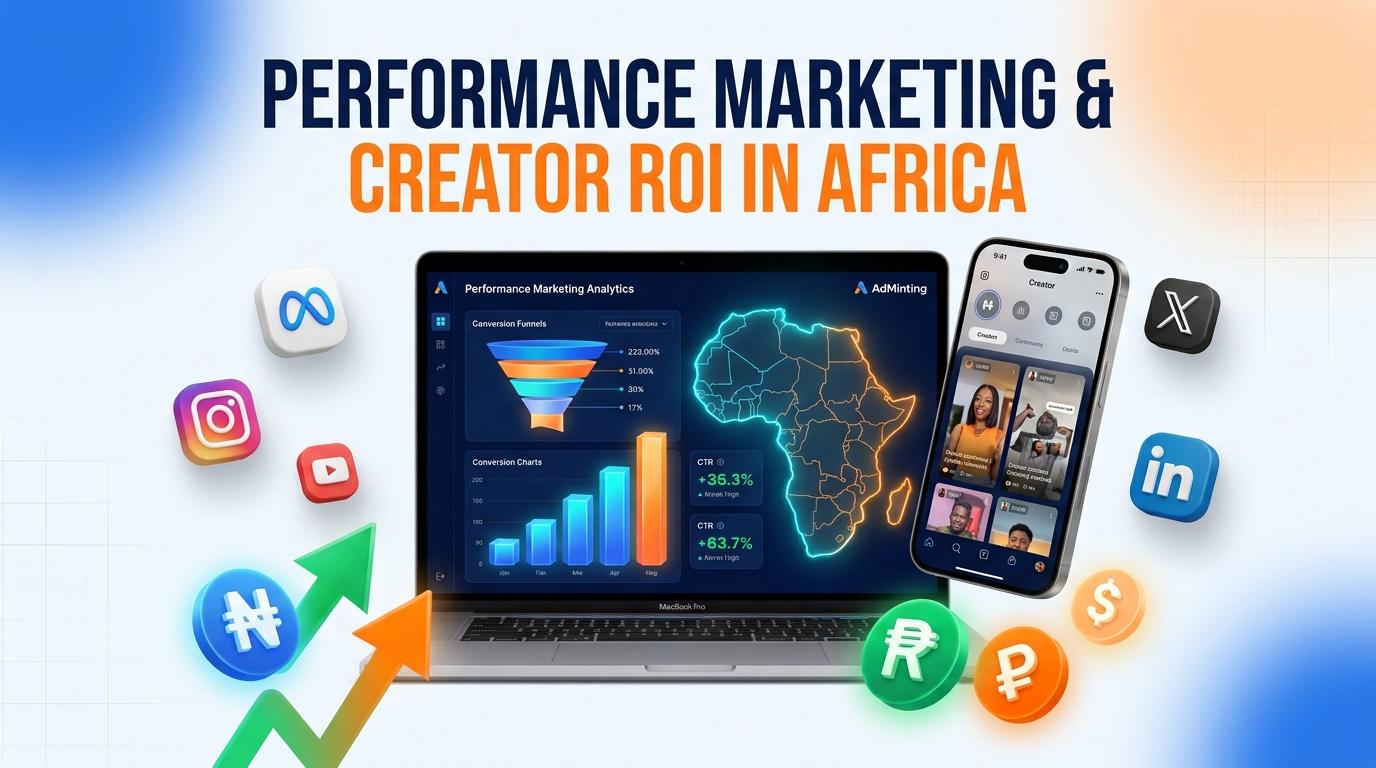
Performance Marketing & Creator ROI in Africa | Adminting

Chukwunyere Ebube
August 20, 2026
Unlocking Performance Marketing: How African Brands Track Real Creator ROI
Imagine this scenario: Your brand allocates a ₦15 million budget to a high-profile macro-influencer campaign in Lagos. The influencer posts a polished 60-second video on Instagram and TikTok, unboxing your newly launched product.
Within 48 hours, the metrics roll in: 500,000 views, 45,000 likes, and thousands of comments filled with heart-eye emojis and phrases like "Need this ASAP!" On paper, the campaign looks like a massive success, but on Monday morning, when your Chief Financial Officer looks at the Shopify and Paystack transaction dashboards, revenue hasn't budget at all.
The sales conversion curve remains flat. When you ask your marketing team why 500,000 impressions didn't translate into sales, you get vague explanations about "brand awareness," "top-of-funnel reach," and "long-term brand sentiment."
Does this sound familiar?
If you are a marketing manager, growth founder, or digital director operating in Nigeria or across the wider African continent, you have likely experienced this exact frustration. For over a decade, African brands have poured millions of Naira, Shillings, and Cedi into influencer marketing, treating it like digital billboards.
Brands paid massive flat upfront fees to creators based on vanity metrics, follower counts, likes, and broad impressions, hoping that social buzz would somehow translate into real revenue.
However, the era of vanity metrics is over. As digital marketing in Africa matures and economic pressures demand higher capital efficiency, brands can no longer afford unmeasurable ad spend. Enter Performance-Driven Influencer Marketing.
The global creator economy has surpassed $250 billion, and Africa’s creator sector is expanding rapidly, reaching $3.4 billion in 2024 and projected to scale beyond $7.2 billion by 2026. Nigeria accounts for 40% of this continent-wide economic engine.
However, recent industry benchmark data reveals a glaring disconnect: over 60% of African content creators earn under $100 per month, largely because brands struggle to measure real bottom-of-funnel impact and hesitate to invest continuously without verified Return on Investment (ROI).
| TRADITIONAL INFLUENCER MARKETING | PERFORMANCE-DRIVEN INFLUENCER |
|---|---|
|
|
Leading African brands across fintech, e-commerce, beauty, and quick-service retail are transforming how they collaborate with creators. Rather than guessing impact, they deploy performance architecture, using multi-touch pixel attribution, customized discount codes, UTM structures, and automated platform rails to connect creator activity directly to final sales.
In this comprehensive guide, we will break down the end-to-end framework African brands use to calculate, track, and optimize real creator ROI. We’ll also examine how Adminting, Africa’s premier performance-driven influencer marketing and niche community platform is solving localized friction points to turn creator partnerships into predictable growth engines.
To understand the practical impact of performance marketing, let's look at a real-life case study.
Consider KultureSkin, an emerging direct-to-consumer (D2C) skincare brand based in Yaba, Lagos. In late 2024, KultureSkin launched a new organic serum tailored for melanin-rich skin. Following the traditional influencer playbook, they spent ₦8,000,000 partnering with four macro-influencers on Instagram, each possessing over 400,000 followers.
The result? The videos generated over 1.2 million combined views, but the website recorded only 140 orders total, generating ₦2,100,000 in gross sales. After factoring in product and shipping costs, KultureSkin lost over ₦6,500,000 on the campaign.
The founders realized they had made a classic mistake: Confusing reach with relevance and impressions with intent.
| Strategy | Spend | Sales |
|---|---|---|
| Macro Strategy | ₦8.0M | ₦2.1M |
| Adminting Micro Model | ₦3.5M | ₦8.4M |
In early 2025, KultureSkin shifted its approach. They stopped paying flat upfront fees based on follower counts and migrated their entire creator deployment strategy to Adminting.com.
Using Adminting’s hyper-localized search, they partnered with 35 nano- and micro-creators across Lagos, Abuja, and Port Harcourt. These creators had smaller followings (between 3,000 and 25,000), but highly engaged audiences interested in skincare and wellness.
KultureSkin integrated Adminting’s tracking pixel onto their store header and issued each creator an automated, custom tracking link alongside a 10% discount code. Instead of paying massive upfront fees, they adopted a hybrid structure on Adminting: a modest base fee to cover production costs (₦30,000 per creator), combined with a 12% automated commission on every successfully attributed sale.
The results transformed their business model:
- Total Campaign Spend: ₦3,500,000 (Base fees + performance commissions)
- Total Direct Sales Generated: ₦8,400,000 (verified by pixel attribution)
- Return on Ad Spend (ROAS): 2.4x
- Customer Acquisition Cost (CAC): Reduced by 48% compared to traditional paid social ads.
By shifting from broad macro-influencers to a performance-tracked micro-creator network, KultureSkin cut ad spend while multiplying real revenue.
By the time you finish reading this exhaustive strategy guide, you will be able to:
- Calculate True Creator ROI: Apply mathematical models and metrics to evaluate campaign profitability beyond vanity engagement.
- Deploy Conversion-Level Tracking: Implement UTM parameter frameworks, custom affiliate codes, and dynamic tracking pixels across African e-commerce and mobile apps.
- Build High-Converting Hybrid Pay Structures: Structure creator contracts using base fees, performance bonuses, and automated commission tiers that align creator incentives with sales goals.
- Overcome African Localized Tracking Friction: Resolve cross-border payment issues, currency volatility, and regional data regulations (such as Nigeria’s NITDA guidelines) using modern platforms like Adminting.
- Scale Campaigns with Micro-Creator Networks: Leverage data-driven creator discovery to build high-converting affiliate and influencer engines.
How Do Successful African Brands Measure Creator Performance?
"How do top digital brands across Nigeria, Kenya, and South Africa accurately track, measure, and scale real sales ROI from creator partnerships without getting burned by fake engagement?"
To answer this question, we must analyze the specific performance frameworks, attribution technologies, and execution strategies used by modern growth teams.
The Complete Performance Marketing Framework for Creator ROI
- 1. DISCOVER & VET
- 2. TRACK & ATTRIBUTE
- 3. PAY FOR PERFORM.
- 4. OPTIMIZE & SCALE
Step 1: Defining the Core Metrics—Beyond Likes and Shares
The Metrics That Actually Matter
Performance-driven influencer marketing shifts focus from vanity metrics (views, likes, comments) to conversion metrics:
- Customer Acquisition Cost (CAC): Total spent on a creator campaign divided by the number of new paying customers acquired.
- Return on Ad Spend (ROAS): Total revenue generated by the creator divided by total spend on that creator.
- Click-Through Rate (CTR): Percentage of viewers who clicked the creator’s specific call-to-action link.
- Conversion Rate (CVR): Percentage of link clickers who completed a target action (purchase, app download, or lead form).
- Average Order Value (AOV): Average monetary spend per transaction coming through a creator’s traffic.
- Customer Lifetime Value (LTV): Estimated total revenue a customer generates over their relationship with your brand.
The Financial Reality
Evaluating campaigns solely on engagement rates creates a false sense of success. A meme creator might generate 200,000 views and a 12% engagement rate, but drive zero purchase intent. Conversely, a niche tech reviewer in Nairobi with 5,000 followers might generate 1,000 views and 40 direct app downloads.
Tracking conversion metrics ensures every Naira, Cedi, or Shilling spent produces measurable business value.
Setting Up Your Metric Tracking Dashboard
To establish clear measurement across campaigns, organize your tracking metrics using this standardized template:
| Metric Category | Formula / Definition | Target Benchmark (African E-Comm/D2C) | Primary Tracking Mechanism |
|---|---|---|---|
| Engagement Rate (ER) | [(Likes + Comments + Shares) / Impressions] × 100 | > 3.5% (Micro) / > 1.5% (Macro) | Native Social Analytics / Adminting |
| Click-Through Rate (CTR) | (Total Clicks / Total Impressions) × 100 | 1.8% – 3.2% | Customized UTM Parameters |
| Conversion Rate (CVR) | (Attributed Sales / Total Clicks) × 100 | 2.0% – 4.5% | Web Tracking Pixel / E-Comm Backend |
| Customer Acquisition Cost | Total Creator Spend / Total Attributed Customers | < 30% of Product AOV | Integrated Platform Dashboard |
| Return On Ad Spend (ROAS) | Direct Attributed Revenue / Total Creator Spend | Minimum 2.5x (Target 4.0x+) | Adminting Performance Pixel |
Step 2: Modern Attribution Mechanisms—How to Trace Every Sale
What is Creator Attribution Architecture?
Attribution architecture is the technical setup used to track a customer's journey from a creator's social media post to a completed purchase or sign-up.
The Attribution Challenge in African Markets
Tracking conversions across African digital channels comes with unique complexities:
- Cross-Platform Browsing: A user might watch a TikTok video, open a WhatsApp group to discuss the product, and finally complete the purchase two days later on a desktop browser.
- In-App Browsing Limitations: Built-in browsers on platforms like Instagram often drop standard cookies when users switch windows or open mobile wallets.
- Offline Payment Methods: High adoption of bank transfers, USSD codes, and mobile money options (e.g., M-Pesa, MTN Mobile Money) requires payment gateways to link back to the originating digital session.
Implementing a Multi-Layered Attribution Engine
To ensure accurate tracking, deploy a three-layered attribution framework:
-
LAYER 1: Custom UTM Parameters
Appended to Bio Links/Swipe-ups (e.g., brand.com?ref=creator_id) -
LAYER 2: Dedicated Promo Codes
Captures cross-device & offline conversions (e.g., CREATOR10) -
LAYER 3: Direct Server-to-Server / Pixel Attribution
Adminting Pixel tracks checkout events via API & webhooks
Layer 1: Custom UTM Parameters
Generate clean, standardized UTM parameters for every creator.
Best Practice: Shorten long UTM links using custom branded short-links or platform redirects (e.g., adminting.link/creatorname) to keep social media bios clean.
Layer 2: Dedicated Creator Discount Codes
Give every creator a unique discount code (e.g., TOLU10 or KENYA15) that offers a small discount (5–10%) to the end consumer.
Why it works: Promo codes act as a reliable backup when cookies fail or when users switch devices. If a customer views a creator’s video on Instagram but buys three days later via a desktop Google search using TOLU10, the sale is still correctly attributed to that creator.
Layer 3: Direct Server-to-Server (S2S) & Web Tracking Pixels
Integrate modern performance pixels, such as the Adminting Tracking Pixel, directly into your website header or server-side API.
<!-- Example: Adminting Performance Tracking Pixel Header Script -->
<script type="text/javascript">
  !function(a,d,m,i,n,t,i_){
    a.AdmintingObject=n;a[n]=a[n]||function(){(a[n].q=a[n].q||[]).push(arguments)},
    a[n].l=1*new Date();t=d.createElement(m),i_=d.getElementsByTagName(m)[0];
    t.async=1;t.src=i;i_.parentNode.insertBefore(t,i_)
  }(window,document,'script','https://cdn.adminting.com/pixel.js','adm');

  adm('init', 'ADM-NIG-88492-X');
  adm('track', 'PageView');
</script>
When a user completes a checkout via Paystack, Flutterwave, or Shopify, the script sends an automated conversion payload back to the Adminting engine:
{
  "event": "Purchase",
  "transaction_id": "PAYSTACK_TXN_9928341",
  "currency": "NGN",
  "value": 25000.00,
  "creator_id": "creator_tolu_302",
  "utm_campaign": "q3_skin"
}
This S2S integration confirms that conversion data remains accurate, even if browser extensions or privacy settings block standard client-side cookies.
Step 3: Structuring High-Converting Creator Compensation Models
Hybrid Performance Pay Contracts
A compensation model that replaces 100% upfront flat fees with hybrid structures, blending a base fee with conversion-tied performance bonuses.
Aligning Incentives Across Both Parties
- Pure Flat Fee: Puts 100% of the financial risk on the brand. Once the creator receives payment, they have little financial incentive to drive actual conversions.
- Pure Commission (Affiliate): Puts 100% of the risk on the creator. High-quality creators often reject pure commission deals from unproven brands because content production requires time, equipment, and production costs.
- The Hybrid Model: Balances risk fairly. The base fee covers the creator's time and production expenses, while the performance bonus rewards them for driving measurable results.
| MODEL TYPE | STRUCTURE | RISK BALANCE |
|---|---|---|
| Pure Flat Fee | 100% Upfront Payment | High Risk (Brand) |
| Hybrid Tiered | Base Fee + Performance Bonus | Balanced Risk |
| Pure Commission | 100% Revenue Share | High Risk (Creator) |
Three High-Performing Compensation Frameworks
The Base + Revenue Share Model (Recommended):
Pay a modest base fee to cover content creation, plus a 10–15% commission on all attributed sales.
Example: ₦40,000 Base Fee + 12% revenue commission on all pixel-tracked checkouts.
The Tiered Conversion Milestone Model:
Pay a flat base fee, with scaled performance bonuses triggered at specific sales milestones.
Base Fee: ₦50,000 for 1 Video + 2 Stories.
Milestone 1: +₦25,000 bonus upon reaching 20 attributed sales.
Milestone 2: +₦60,000 bonus upon reaching 50 attributed sales.
Milestone 3: +₦150,000 bonus upon reaching 120 attributed sales.
Cost Per Action (CPA) / Cost Per Lead (CPL) Model:
Ideal for fintechs, mobile apps, and SaaS platforms looking for app installs or user sign-ups rather than immediate product sales.
Structure: Pay ₦1,200 per verified app download and BVN/NIN account verification.
Step 4: Solving African Regional Friction with Adminting Infrastructure
Executing performance marketing campaigns in markets like Nigeria, Kenya, Ghana, or South Africa presents operational challenges that Western platforms rarely address.
| REGIONAL CHALLENGE | HOW ADMINTING SOLVES IT |
|---|---|
| High Currency Volatility | Multi-Currency Wallets & FX Locking |
| Payment Fragmentation | Integrated Local Rails (Paystack, etc) |
| Regulatory Compliance (NITDA) | Automated Data Protection Standards |
| Fake Followers / Bot Engagement | AI Vetting & Local Audience Splits |
-
Payment Fragmentation & Localized Rails
The Challenge: Paying dozens of micro-creators across different banks, mobile money wallets (M-Pesa, Telebirr, MoMo), and African currencies creates significant administrative overhead. International platforms using PayPal or wire transfers often result in high FX fees and delayed payouts.
The Adminting Solution: Adminting integrates directly with localized payment rails like Paystack and Flutterwave. Brands deposit funds in their local currency (NGN, KES, GHS, ZAR, or USD), and Adminting automates milestone payouts directly into creators' local bank accounts or mobile wallets as performance targets are met.
-
Currency Volatility & Escrow Protection
The Challenge: Currency fluctuations make budgeting across multi-month campaigns difficult.
The Adminting Solution: Adminting uses an automated smart-contract escrow system. Campaign budgets are locked at launch. Funds are held safely in escrow and released to creators only when verified pixel tracking confirms deliverables and performance thresholds have been met.
-
Data Privacy Regulations (NITDA & GDPR Compliance)
The Challenge: Marketing campaigns processing user data must comply with regional regulations, such as Nigeria's Data Protection Act (NDPA/NITDA) and South Africa's POPIA.
The Adminting Solution: Adminting operates with privacy-first infrastructure. All attribution pixels rely on anonymized event tokens and first-party transaction data, ensuring full compliance with local regulatory frameworks.
-
Micro-Creator Discovery & Fake Engagement Filtering
The Challenge: Many creators purchase fake followers or use engagement pods to artificially inflate their metrics.
The Adminting Solution: Adminting filters through a database of over 60,000 vetted African Key Opinion Leaders (KOLs) and micro-promoters. The platform uses AI to analyze audience geographic distribution—ensuring, for example, that at least 30–40% of a creator’s active following is physically located in key target hubs like Lagos, Nairobi, or Accra—while filtering out bot accounts.
Step 5: Advanced Optimization—How to Scale Creator Campaigns
Once you've established tracking and run initial tests with micro-creators, the next step is systematic scaling.
- PHASE 1: TEST — Deploy 15-20 Micro-Creators with low base fees
- PHASE 2: ANALYZE — Identify top 20% high-performers via ROAS & Conversion Data
- PHASE 3: DOUBLE DOWN — Move top performers to long-term retainers & whitelist ad spend
- PHASE 4: CUT LOSSES — Offboard low-converting creators immediately
- The 80/20 Creator Rule: In most performance campaigns, roughly 20% of participating creators generate 80% of total conversions. Use your tracking dashboard to quickly identify top performers.
- Move Top Performers to Retainers: Re-invest in your top-performing creators by offering 3- to 6-month ambassador retainers. Consistent messaging builds deeper trust with their audience, driving higher conversion rates over time.
- Whitelisting & Meta/TikTok Spark Ads: Secure rights to run paid ads through your top-performing creators' social handles (whitelisting). Ads run through authentic creator profiles often deliver lower Cost Per Click (CPC) and higher ROAS compared to standard brand page ads.
Addressing Common Implementation Questions
"What if our product is expensive or has a long sales cycle? Can we still use performance-driven creator marketing?"
Yes, absolutely. For high-ticket products, such as real estate developments, high-end electronics, enterprise B2B software, or premium financial services, customers rarely make impulse purchases on their first visit.
In these scenarios, adapt your performance marketing model using a Multi-Step Conversion Strategy:
- Track High-Intent Soft Conversions: Instead of tracking immediate product sales, tie creator compensation to high-intent micro-conversions. Examples include test drive bookings, qualified lead form submissions, webinar registrations, or free-trial sign-ups.
- Extend Your Attribution Window: Standard e-commerce attribution often relies on a 7-day click window. For high-ticket items, adjust your tracking parameters to a 30-day or 60-day attribution window.
- Combine Retargeting Pixels with Creator Traffic: Build custom retargeting audiences on Meta and Google from users who clicked a creator's link. Re-engage these visitors with retargeting ads, ensuring your brand stays top-of-mind throughout their decision-making process.
Conclusion
The era of spending unmeasurable ad budgets on unverified creator reach is behind us. In today's competitive landscape, growth demands accountability, precise measurement, and clear ROI.
By deploying a robust performance framework, combining UTM tracking, custom discount codes, server-to-server pixels, and hybrid compensation models, your brand can turn creator partnerships into a predictable, revenue-generating growth channel.
You don't need to navigate this transition alone. Adminting.com provides the end-to-end infrastructure required to execute performance-driven creator campaigns across Nigeria and Africa. From verified micro-creator discovery and automated tracking pixels to localized multi-currency payouts, Adminting helps you turn creator content into verified business growth.
Ready to scale your creator ROI? Stop guessing your influencer campaign impact. Build your first performance-tracked campaign on Adminting today. 👉 Visit https://adminting.com to launch your campaign.
FAQ
-
1. How does performance-driven influencer marketing differ from traditional influencer marketing?
Traditional influencer marketing focuses primarily on top-of-funnel reach—such as impressions, views, and likes—and typically relies on flat upfront fees. Performance-driven influencer marketing focuses on bottom-of-funnel conversions, such as clicks, app downloads, and verified sales. It utilizes attribution tracking (pixels, UTMs, promo codes) and structures compensation around hybrid or commission-based models aligned with real revenue.
-
2. How does the Adminting Pixel work with custom e-commerce stores or Shopify?
The Adminting Pixel is a lightweight JavaScript snippet placed in your website header or integrated into custom e-commerce checkout systems. When a visitor arrives via a creator’s tracking link and completes a purchase, the pixel securely transmits anonymized order data back to your campaign dashboard, assigning revenue to the correct creator in real time.
-
3. Why should brands prioritize micro-creators over macro-influencers for sales conversions?
While macro-influencers excel at broad brand visibility, micro-creators (5,000 to 50,000 followers) often maintain tighter niche communities and higher engagement rates. Their recommendations frequently carry stronger personal credibility, yielding higher click-through and conversion rates at a lower customer acquisition cost.
-
4. How can African brands handle cross-border payments for creators in different countries?
Managing multi-currency creator payments across countries like Nigeria, Kenya, Ghana, and South Africa can be complex due to FX volatility and fragmented banking systems. Adminting simplifies this process by integrating localized payment rails directly into its platform, allowing brands to fund campaigns seamlessly while creators receive automated payouts in their local currency or mobile money wallet.
-
5. What is a healthy Return on Ad Spend (ROAS) for a performance-driven creator campaign?
For D2C e-commerce and retail brands operating across African markets, a target ROAS of 2.5x to 4.0x is generally considered healthy. This ensures your campaign covers product costs, content creation fees, and platform overhead while delivering clear net profitability.
References
- Adminting Platform: Top Performance-Driven Influencer Platforms of 2026. Available at: https://www.adminting.com/blogs/performance-driven-influencer-platforms-2026
- Adminting Insights: Influencer Marketing Agencies: A Guide to Authentic Growth. Available at: https://www.adminting.com/blogs/influencer-marketing-agencies-authentic-growth
- TechCabal & Coachli Data: Africa’s Creator Economy Trends & $7.2B Growth Outlook (2024–2026). Available at: https://coachli.co/blog/africas-creator-economy-2026-trends-2b-opportunities
- Techpoint Africa: Africa Creator Economy Report: Creator Monetization Realities. Available at: https://techpoint.africa/news/africa-creator-economy-report-2026/
- Digitas Africa Analysis: The Next Global Marketing Frontier: Africa's Creator Economy. Available at: https://www.digitas.com/en-za/pressroom/next-global-marketing-frontier-africas-creator-economy
Recommendation
To continue sharpening your performance marketing strategy, explore these related guides from the Adminting resource library:
- 📚 Top Performance-Driven Influencer Platforms of 2026: A detailed breakdown of the software and platform choices driving global and African performance campaigns.
- 📚 Influencer Marketing Agencies: A Guide to Authentic Growth: Learn how to transition from legacy agency models to scalable, tech-enabled creator networks.
- 🚀 Ready to launch your performance campaign? Sign up at Adminting.com to access vetted creators, tracking pixels, and automated ROI reporting today!